

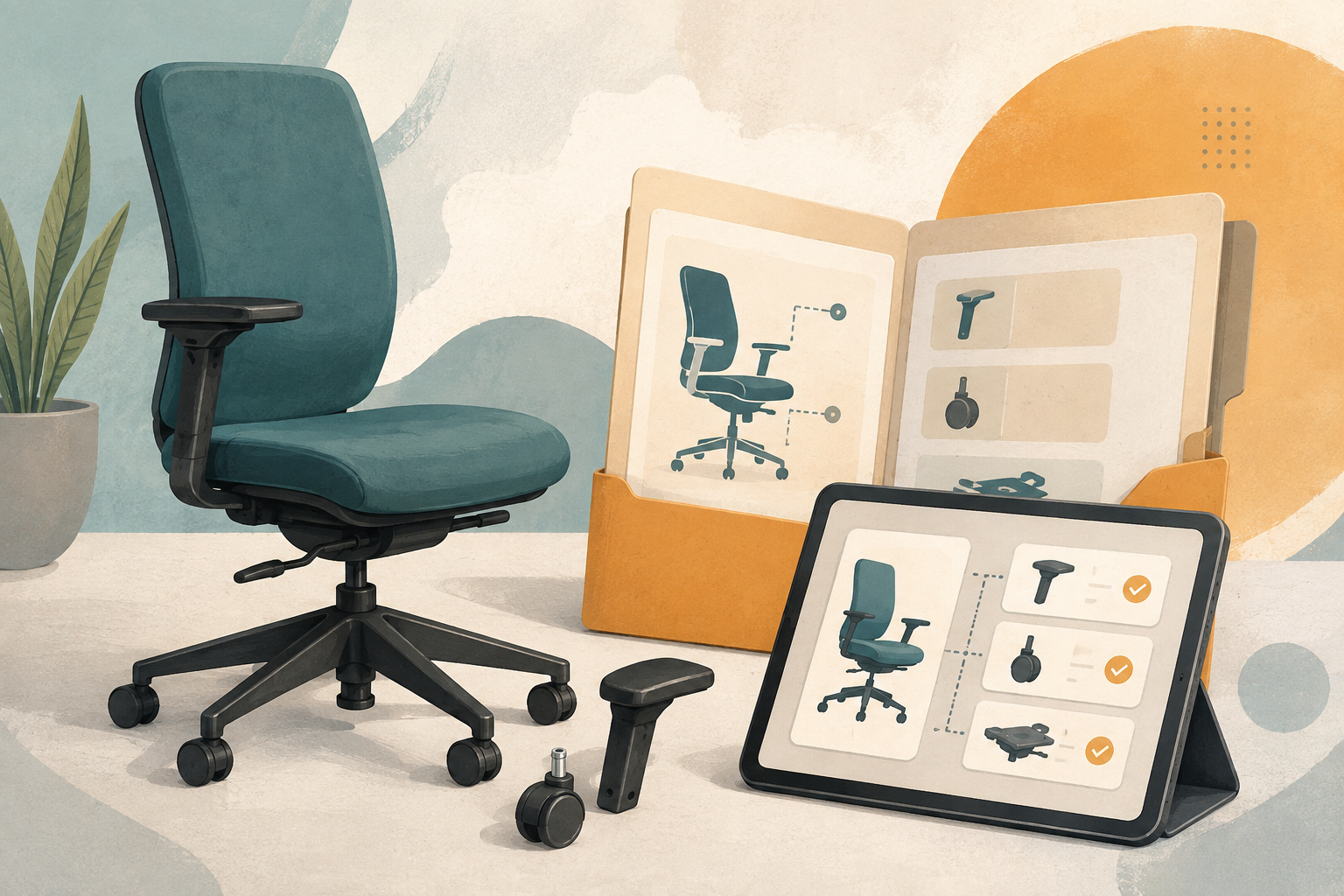
Office chair repair can stall before anyone picks up a tool. The service team first needs to identify the chair configuration, confirm the correct component and establish what has already been replaced. Without that context, a specific repair request becomes a search through orders, photographs and old email conversations.
For furniture dealers, workplace project teams and facilities managers, the opportunity starts at handover. Deliver the information needed to maintain the furniture alongside the furniture itself. The aim is not a bigger archive: it is a record that allows the next person to act without reconstructing the original project.
Material information is not a repair plan
A recycled-material specification does not identify the armrest that fits a particular chair. Treat material evidence, maintenance instructions and spare-part availability as separate questions. A product may be well documented in one respect while leaving another unresolved.
The EU Ecolabel furniture manual addresses spare parts and disassembly separately. It offers a useful reference, not proof that every chair is repairable.
The product records office chair repair needs
Separate model-level information from the record for the delivered item. A manual may cover a whole range; configuration, location and service history belong to the individual chair. Preserve that connection when furniture moves between rooms or sites.
- Record the model, configuration, order reference and an identifiable asset number. Add a serial number and a photograph of the product label where available.
- Keep relevant component references and obtain supplier confirmation of compatibility. Similar appearance does not establish a suitable replacement.
- Attach the applicable versions of maintenance and assembly instructions, including their source and the date they were checked.
- Identify the parts contact, current lead time and warranty conditions that need checking.
- Record each request, diagnosis, intervention and outcome, including any component change.
Label missing information as unknown and assign someone to resolve it. A visible gap is more useful than an assumption that later gets treated as verified data.
Turn a request into a decision
Consider a hypothetical customer reporting a damaged armrest. This is an illustrative workflow, not a customer case study. The request includes the asset number, location and photographs. Service checks the configuration and previous work, confirms the replacement component where necessary, then considers repair, reuse of a compatible component or replacement.
The component price is only part of that assessment. Availability, required expertise, transport, downtime and the remaining condition of the chair also matter. A qualified party should assess technical suitability and safe execution. A complete digital record cannot replace that judgement.
Agree who maintains the information
Sales should hand over the agreed configuration, project delivery should check the installed location, and service should maintain intervention records. Agree with the customer who reports moves and changes. Otherwise, even a carefully prepared record can drift away from the furniture it describes.
Start with one project or a frequently supplied chair model. Use real requests to identify missing fields and repeated questions for basic information. This reveals where work is being duplicated without promising an unsupported time-saving figure.
Put the record to work in aftercare
Furnify connects furniture records with locations and documents. Its Service & Ticketing workflow connects requests to the relevant furniture and customer.
That shared context supports coordinated follow-up. It does not automatically fill gaps in supplier documentation or guarantee that a spare part exists. The value depends on keeping the information current and using it when decisions are made.
To explore the fit for your dealership, discuss one real aftercare workflow with Furnify, from the first customer request to the completed repair. It is a more focused starting point than digitising every document at once.